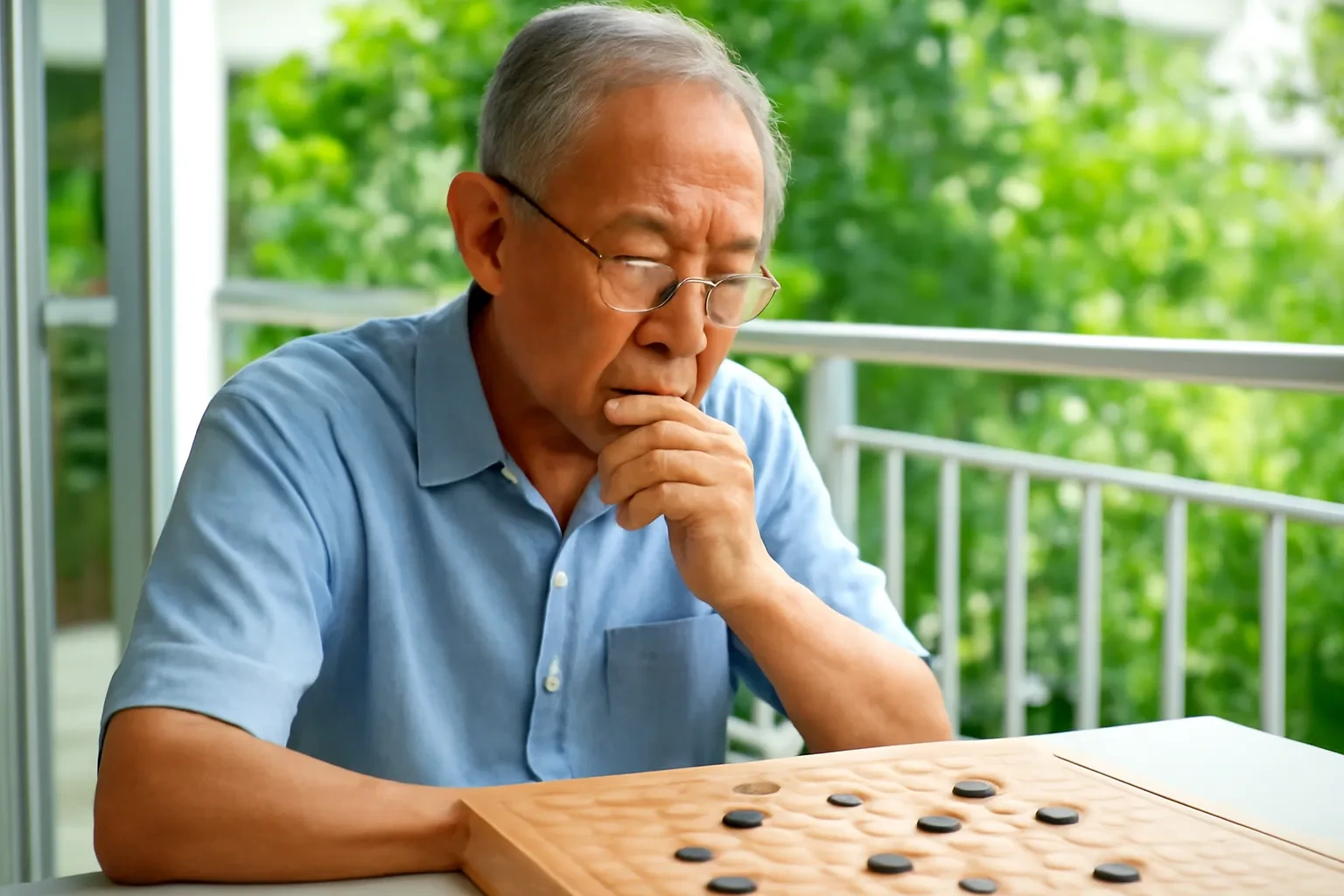
Every Go game reaches a point where one side has a group of stones that is not yet safe. It has no two eyes, it has no clear way to get them, and it is surrounded on more than one side. That group is weak, and the player who owns the stronger stones nearby has a decision to make: how should they attack it?
Most beginners answer that question the same way. They try to kill the group. They chase it, surround it, cut off its escape, and hope it dies. Sometimes it does. More often the group runs, makes eyes, or connects to friends, and the attacker ends up with a line of stones that did nothing useful.
Stronger players think differently. The purpose of attacking a weak group is usually not to kill it. The purpose is to gain something while the opponent is busy saving it. This article explains what that something is, how to spot a group worth attacking, and the few principles that make attacks work.
What makes a group weak
A group is weak when it cannot make two eyes easily and cannot connect to a strong group easily. That is the whole definition. A long line of stones can be weak; a single stone can be strong if it sits next to a solid wall. Size does not matter, safety does.
Look for these signs:
- The group sits in the middle of the opponent's sphere of influence, far from its own friends.
- It has no base: there is no room along the edge to make an eye shape.
- It has few liberties, or its liberties are about to be taken.
- Your opponent keeps adding moves to it, which means they are worried about it too.
A weak group is a liability for its owner. Every move they spend on it is a move they do not spend elsewhere. That is the lever you pull.
What an attack actually gains
When you attack well, one or more of the following happens:
- You build territory while chasing. The stones you place to press the weak group also close off an area on your side. By the time the group is safe, you have a large, solid territory that did not exist before.
- You build influence. Your attacking stones form a wall facing the centre or another part of the board, which you can use later.
- You gain the initiative. Your opponent answers your attacking moves, so you decide where the game goes next.
- You weaken a second group. Often the running group crashes into another weak group, and now your opponent has two problems at once.
- Sometimes, the group dies. If your opponent ignores it or misreads, you capture it. Treat this as a bonus, not the plan.
An attack that gains none of these was not really an attack. It was just chasing.
Attack from the side that helps you
The most common attacking mistake is choosing the wrong direction. You can usually press a weak group from two or three sides. Before you play, ask: which side do I want my stones on after the fight?
The answer is almost always the side where your own territory or influence is. If you have a corner on the left, attack the weak group in a way that pushes it away from your corner and toward the open centre or toward your opponent's strong stones. Your attacking stones then join your corner, making it bigger and safer. If you attack from the other direction, you push the group into your own area, and it lives there by eating your territory.
A useful habit: before an attacking move, picture where the weak group will run. Then make sure it runs away from what you care about.
Keep your distance
Contact moves feel strong. Placing a stone directly against the weak group, taking a liberty, looks aggressive. But contact also helps your opponent: every stone you put next to theirs gives them something to push against, and pushing creates shape and eyes.
Attacks that work tend to come from a distance. A move one or two lines away from the weak group takes away the space it needs for a base without giving it a stone to lean on. You deprive it of eye space rather than liberties.
A rough rule for the middle game: attack weak groups with loose moves, fight strong-looking groups with contact moves. It sounds backwards, but it matches how groups actually live and die.
Make yourself strong first
You cannot attack from weakness. If your own stones near the fight are thin, with cutting points or no eyes of their own, your opponent will counter-attack. The running group suddenly cuts your stones apart, and now you have two weak groups while they have one.
Before launching an attack, check your own stones. If there is a cutting point, consider fixing it first. A quiet solid move that removes your weakness is often the strongest preparation for an attack a few moves later. Go players sometimes say you should defend before you attack, and it is one of the most reliable proverbs in the game.
The splitting attack
The most powerful form of attack is splitting two weak groups apart. If your opponent has two groups that are both unsettled, and you can place stones between them, they cannot help each other. Every move they make to save one leaves the other exposed.
Splitting attacks work because your opponent can only answer one threat at a time. You press one group; they defend; you press the other; they defend again. Meanwhile your stones in the middle grow into a strong framework. Often you do not capture either group, but you end up with far more territory than your opponent.
Look for moments when your opponent has two stones or groups on either side of an empty area, both far from safety. A move in the middle of them is frequently the best move on the board.
When killing is the right goal
There are times to go for the kill:
- The group has very little eye space and no route to friends, and you have read that it cannot live.
- Your opponent has already invested many stones in it, so capturing it would decide the game.
- You are behind, and only a big capture can win.
Even then, read carefully. A kill that fails is costly: you have placed many stones around a group that lives, and those stones are often weak themselves. If you cannot see the kill clearly, choose the attack that gains profit instead.
A simple example
In this 9×9 position, the two white stones float between Black's areas. Killing them outright would be hard; they have plenty of room to run. But Black does not need to kill them. By playing moves that deny them a base at the bottom, Black makes White spend moves running while Black's lower side turns into solid territory. That is a successful attack even if White lives.
Practising attacks
The best way to learn attacking is to play full games and review them. After each game, find one fight where you had a chance to attack and ask:
- Did I know which of their groups was weak?
- Which direction did I push it, and was that the right direction?
- What did I gain while it ran?
Playing the computer on the home page is useful for this: at the lower levels the computer often leaves groups weak, which gives you chances to practise pressing them. Then try the same ideas against real opponents on the online page, where people defend more stubbornly. If you sign in on the account page, your games are saved so you can replay the key fight afterwards.
For related ideas, read about capturing races, and browse the fighting category.
Frequently asked questions
Should I always attack a weak group I see?
No. First check whether your own nearby stones are safe, and whether a bigger move exists elsewhere. Attacking is good when it gains more than a quiet big move would.
Why did my attack end with the group alive and my stones weak?
Usually because the attack came from the wrong direction or used too many contact moves. Contact gives the defender shape. Attack from a distance and push the group away from your own area.
Is it bad if the group I attack lives?
Not at all. If you built territory or influence while it lived, the attack succeeded. Living in a small, cramped shape while the attacker gains a big area is often a loss for the defender.
What is the difference between attacking and chasing?
Chasing follows the group around with no purpose. Attacking chooses moves that are useful for you whether or not the group dies.
How do I know if a group can live?
Count its eye space and check whether it can connect to friends. If you are not sure, assume it can live and attack for profit rather than for the kill.