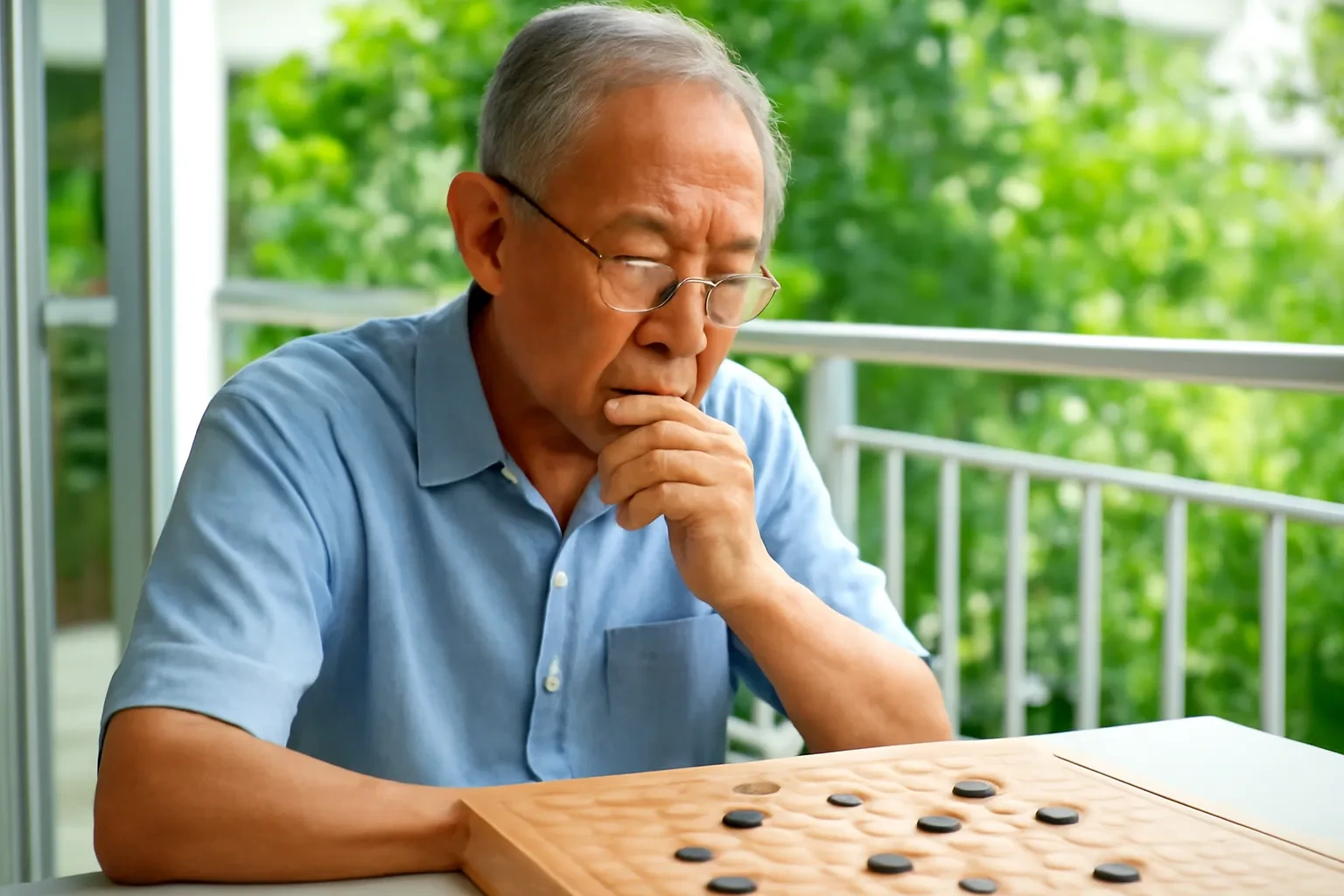
Sooner or later in every game of Go, two groups end up locked together. Your group has no eyes, their group has no eyes, and neither can escape. They are surrounding each other. Whoever captures first wins the whole fight. This situation is called a capturing race, or semeai in the Japanese term many players use.
Capturing races look complicated, but they rest on one simple idea: count liberties. The group that runs out of liberties first dies. If you can count accurately and fill liberties in the right order, you will win races you used to lose by one move.
What a capturing race is
A liberty is an empty point directly next to a group, along the lines. A group with no liberties is captured. In a capturing race, two groups share some liberties and each group also has liberties of its own.
The race works like this: each player takes turns filling the other group's liberties. When one group reaches zero, it is removed. Because players alternate, a group with even one more liberty than its opponent will usually win, and the player whose turn it is gets the advantage of moving first.
The three kinds of liberties
To count a race correctly, sort the liberties into three types.
- Outside liberties belong to only one group. They are the empty points around your group that your opponent must fill to capture you, but that do not touch their group.
- Shared liberties touch both groups. Filling one reduces both groups at once.
- Eye liberties are inside an eye of one group. They count as liberties, and they are especially valuable, as explained below.
The order in which you fill these matters a great deal.
Fill outside liberties first
This is the most important practical rule. When you attack in a race, fill your opponent's outside liberties before the shared ones.
Why? Because filling a shared liberty also takes away one of your own liberties. If you fill shared points too early, you shorten both groups equally and gain nothing. Worse, you might run your own group out of liberties before theirs. Outside liberties only hurt your opponent.
Shared liberties are filled last. When only shared liberties remain, the player who fills one while still having more liberties left gets closer to capturing, but by then the count has usually been decided.
A simple count
When you look at a position like this, do not guess. Point at each empty point next to the black group and name whether it also touches the white group. Then do the same for White. Here the count takes five seconds and tells Black to stop investing in these stones. Players who win races are not faster readers; they are more careful counters, and counting also tells them which fights are already over.
Counting the result
Once you know the liberties, the result usually follows a pattern for races with no eyes:
- If your outside liberties plus shared liberties are more than your opponent's, and it is their move, you usually win.
- If both groups have the same number of liberties, whoever moves first wins.
- If the groups have only shared liberties and neither can fill them without killing itself, the result can be seki, where both groups live without eyes.
These are guidelines. Real positions have extra details: a group might be able to extend its liberties by connecting to another stone, or a filling move might be impossible because it is self-atari. Always check the position, not only the formula.
Eyes change everything
An eye inside a group gives it liberties that the opponent cannot fill easily. To fill an eye liberty, the opponent must play inside the eye, which only works when that move captures or when the eye is the last liberty.
Several rules follow from this:
- A group with one eye usually beats a group with no eyes, even if the numbers look close. The eyeless group's liberties can be filled from outside, but the one-eyed group's eye liberty is filled last.
- Bigger eyes give more liberties. A three-point eye space counts as more liberties than a one-point eye, because the attacker must fill it gradually. Experienced players memorise that a three-space eye gives three liberties, a four-space eye five, a five-space eye eight, and a six-space eye twelve. You do not need these numbers yet, but know that big eyes are powerful in races.
- When both groups have one eye, count the outside liberties and shared liberties again; shared liberties behave differently in this case, and the race often turns on who has more outside liberties.
The practical lesson: in a close race, making an eye for your group is often worth more than filling another liberty of your opponent's.
Approach moves
Sometimes you cannot fill a liberty directly because doing so would put your own stone in atari. You need an extra move first to make the fill safe. That extra move is called an approach move. Approach moves cost you tempo, which means they effectively add liberties to your opponent's group. When you count a race, add one liberty to the opponent for every approach move you would need.
Ways to gain a liberty
When you are behind in a race, look for:
- Connecting to friendly stones that have their own liberties.
- Capturing a cutting stone, which often gives both new liberties and an eye.
- Forcing moves that make your opponent answer, giving you a free move to add a liberty.
- Tricks at the edge, where your opponent's filling move would put their own stones in atari.
When you are ahead, the best move is often simply to fill an outside liberty calmly and keep the count.
Seki: when nobody wins
Seki happens when two groups share liberties and neither can fill them without putting itself in atari. Both groups stay on the board and live. Under area scoring, as used on this site, the stones in seki count as points for their owners, and the shared empty points count for nobody.
Seki is not a failure. If your group was going to die and you can reach seki, you have saved it. If your opponent's group was going to die and it reaches seki, you missed something. Recognising seki early helps you decide whether a race is worth playing at all.
Common mistakes in races
- Not counting. Most lost races are lost by one liberty that the player never counted.
- Filling shared liberties first. This shortens your own group for no gain.
- Ignoring the edge. Near the edge, some liberties cannot be filled without an approach move.
- Forgetting that the opponent moves too. Always count as if they will play their best move after yours.
- Playing a race you already lost. If the count says you lose by two, adding stones only loses more. Play elsewhere and treat the stones as sacrificed.
Practice routine
Races are a reading skill, and reading improves with repetition. A good routine:
- When a race appears in your game, stop and count every liberty aloud before moving.
- After the game, replay the race and check whether your count was right.
- Play many short 9×9 games against the computer on the home page, where races come up quickly.
If you sign in on the account page, games are saved, so you can replay each race move by move. When you are ready, test your counting against people on the online page.
For related topics, see attacking weak groups and the life and death category.
Frequently asked questions
What is the most important rule in capturing races?
Count liberties, and fill your opponent's outside liberties before the shared ones.
Why did I lose a race when we had the same number of liberties?
With equal liberties, the player who moves first wins. If your opponent started filling first, they won by one move.
Does an eye really help in a race?
Yes. An eye gives liberties that the opponent must fill last. A group with one eye usually beats a group with none.
What is seki?
Seki is a standoff where two groups share liberties and neither can capture the other. Both groups live.
How does seki count under the rules on this site?
This site uses area scoring. Stones in seki count for their owners; empty points shared in seki count for nobody.