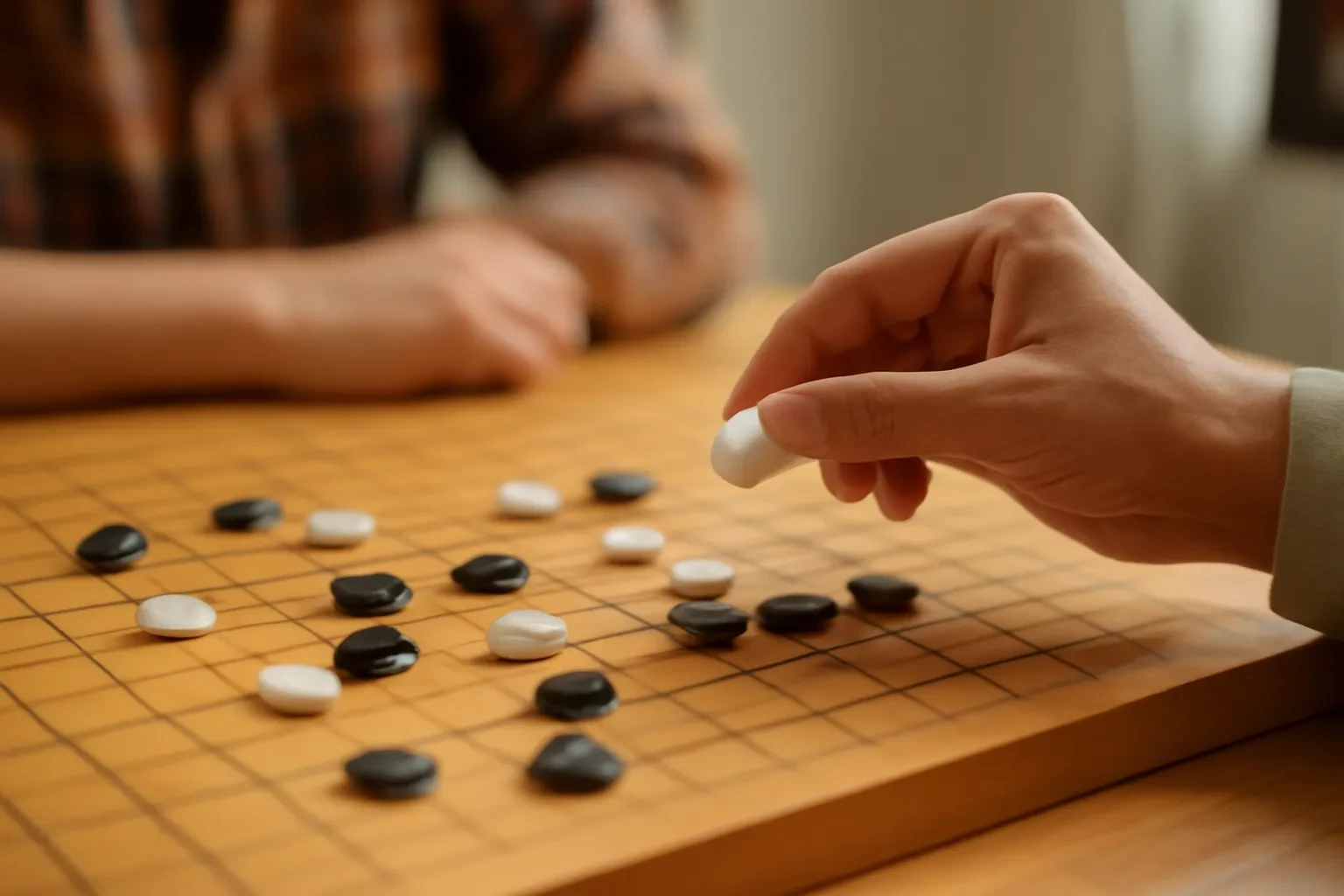
A game of Go is often described in three stages: the opening, the middle game and the endgame. The endgame has its own name borrowed from Japanese: yose. It is the part of the game where the big areas are already decided and both players are closing the borders between them, one point at a time.
Many players, especially in their first year, treat the endgame as a formality. The fighting is over, the territories are clear, so they fill in the last moves quickly and count. That is a mistake. In close games, the endgame regularly decides the winner, and a player who handles it well can gain ten points or more over a player who does not.
When does the endgame start?
There is no single moment. Roughly, the endgame begins when:
- Every group on the board is either clearly alive or clearly dead.
- The remaining empty areas are bounded on most sides.
- The moves left are mostly on the boundaries between territories.
On a 9×9 board, this can happen after twenty or thirty moves. On 19×19, it might be after a hundred and fifty. The key sign is that there are no more weak groups to attack; the game has become a matter of counting and boundaries.
The three kinds of endgame
Players often divide yose into three phases:
- Large endgame. Moves that change the score by many points, often at the edges of big territories or where a single move can push deep into an area.
- Middle endgame. Moves worth a handful of points, usually closing gaps along the second or third line.
- Small endgame. Moves worth one or two points, down to the last neutral points.
The order matters: large moves first, small moves last. Playing a one-point move while a ten-point move is still available is a common way to lose.
Sente and gote
Two words run through all endgame thinking:
- Sente means your move forces an answer. After your opponent responds, it is your turn again.
- Gote means your move does not force an answer. After it, your opponent can play wherever they want.
A sente move is valuable because you gain points and keep the initiative. A gote move gives the initiative away. In the endgame, a small sente move is often worth more than a slightly larger gote move, because you get to play the next big move too. There is a full article on sente and gote in the endgame.
Estimating move value
Endgame skill comes down to knowing how much each move is worth. A simple method: imagine the move played by you, then imagine it played by your opponent, and count the difference in the final score. That difference is roughly what is at stake at that point.
You do not need exact numbers at first. Even rough estimates like "this is big, that is small" will improve your endgame immediately. The article on endgame move values explains the counting in more detail.
The edge matters
Many endgame moves happen on the first and second lines. A move on the second line that pushes into your opponent's territory can gain several points and often forces a reply. The same move played by your opponent into your area loses you the same amount. That is why experienced players look carefully at every edge before choosing an endgame move.
Common edge moves include the hane (a move bending around the end of your opponent's line of stones) and the descent (extending straight down to the first line). Each has a typical value and a typical answer, and learning them is part of learning yose.
Endgame under area scoring
This site uses area scoring: at the end, you count your stones on the board plus the empty points surrounded only by your stones. Komi is 7.5 points for White.
Under area scoring, the endgame logic is almost the same as under territory scoring, with one difference: the last neutral points, called dame, are worth one point each, because a stone played there counts as a point. So under area scoring you should fill dame before passing. There is a separate article on dame and neutral points.
The other practical rule on this site: the game ends when both players pass in a row, and the score is counted from the stones on the board. Capture any dead stones before passing. If you pass with your opponent's dead stones still sitting in your area, they will be counted as alive.
Why endgame skill wins games
Consider two players of equal strength who reach the endgame with the score almost even. One of them:
- plays the biggest move each time,
- takes sente moves before gote moves,
- answers only the threats that matter.
The other plays the first endgame move they see. The first player will usually finish several points ahead, and in a close game that is the result. Endgame skill does not look dramatic, but it is one of the most reliable ways to win more games.
Practise the endgame
Play small boards. On 9×9 games against the computer on the home page, the endgame arrives quickly, and you can practise counting and choosing the biggest move every game. Play people on the online page to test your yose against stubborn defenders.
Sign in on the account page to save your games. When you replay one, stop at the start of the endgame and ask: which move was the biggest here? Then compare it to what you played. This single habit teaches more about yose than any list of rules.
Yose on different board sizes
The endgame looks different depending on board size. On 9×9, almost every move after the opening fight is already an endgame move: borders are short and each point matters a great deal. On 13×13, there is a clear middle game and a clear endgame, which makes it a good size for learning the order of big and small moves. On 19×19, the large endgame can itself be long and complex, with several borders across the board competing for attention.
Because of this, many teachers recommend practising the endgame on small boards first. You can play 9×9 and 13×13 against the computer on this site, and all three sizes against people online. Start small, build the habit of choosing the biggest move, and the same habit will carry over to full-size games.
Frequently asked questions
What does yose mean?
It is the Japanese word used by Go players worldwide for the endgame, the stage where borders are closed and points are counted.
Is the endgame really important?
Yes. In close games, the endgame often decides the winner by a few points.
What should I play first in the endgame?
The biggest move available, and among moves of similar size, the one that is sente.
Why do I need to capture dead stones before passing on this site?
Because the site counts the stones on the board after two passes. Dead stones left in your area are counted as alive.
Are neutral points worth anything?
Under area scoring, as used here, filling a neutral point gains one point, so fill them before passing.