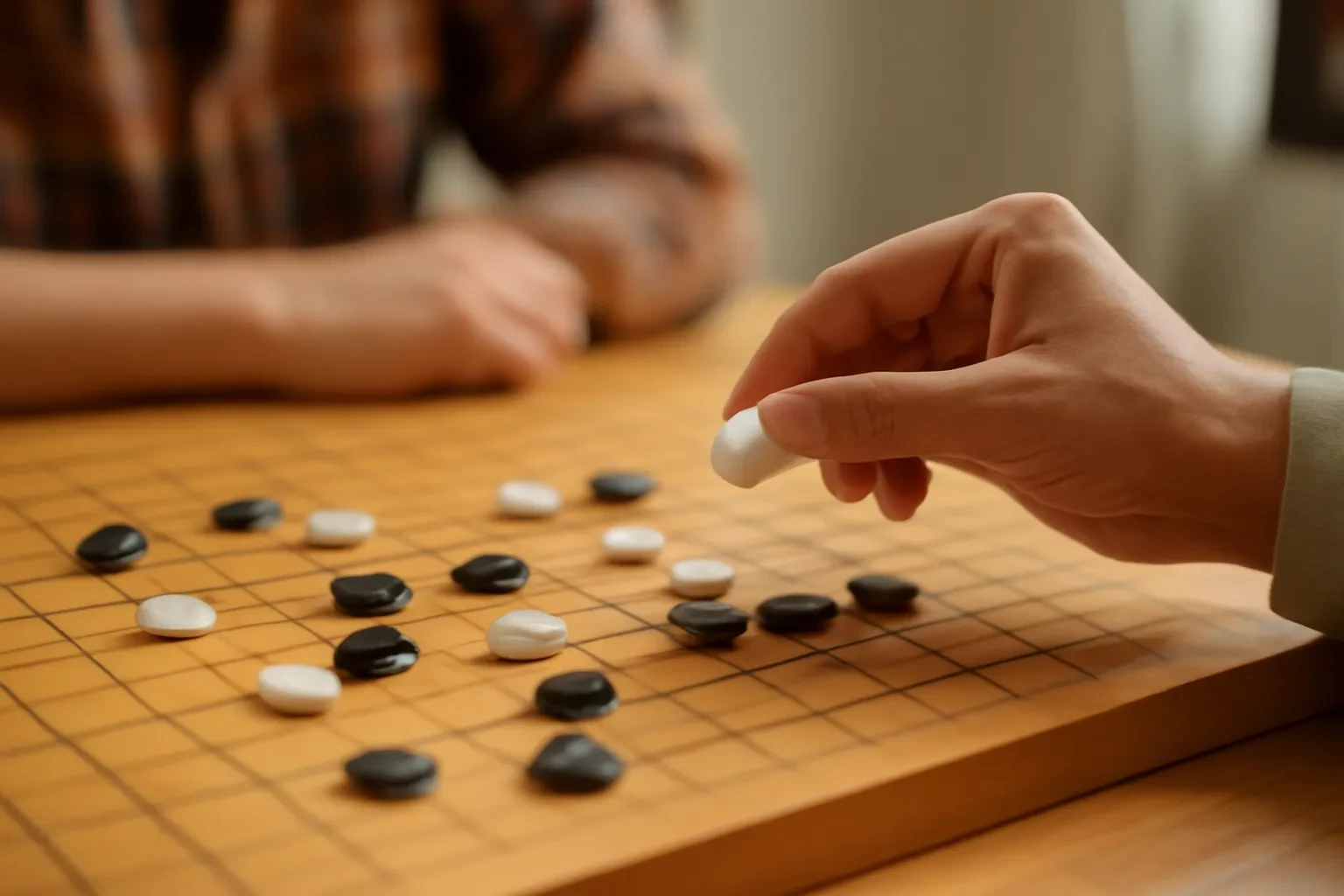
If there is one idea that separates a good endgame from a bad one in Go, it is the difference between sente and gote. Two moves can be worth exactly the same number of points and still have very different value, because one of them keeps the initiative and the other gives it away. Understanding this changes the order in which you play almost every endgame move.
Definitions
- A move is sente if your opponent must answer it, usually because ignoring it would cost them much more than the move itself. After they answer, it is your turn again.
- A move is gote if your opponent does not need to answer. After you play it, your opponent chooses where to play next.
Sente does not mean "aggressive" and gote does not mean "passive". They simply describe who gets to move next.
Why sente is valuable
Imagine two moves on the board. Move A is worth four points and is sente. Move B is worth six points and is gote. Which should you play first?
If you play A, your opponent answers, and then you also play B. You get both. If you play B first, your opponent is free to play A themselves, and in many positions their version of A is sente against you. You get B, they get A.
In the first case you gained both moves. In the second you traded one for one. That is the power of sente: it adds a move to your side of the ledger. A rough rule used by many players is that a sente move is worth about twice as much as a gote move of the same size.
Four kinds of endgame move
Endgame moves are often grouped by who gains sente:
- Double sente. Sente for whoever plays it. If you play it, your opponent must answer; if they play it, you must answer. These are the most urgent moves on the board. Play them as early as you safely can.
- Sente for one side. Sente if you play it, gote if your opponent plays it. You can often delay it, because it will still be sente later, but be careful: if your opponent plays there first, it becomes a gote move for them that takes points from you.
- Reverse sente. A gote move that prevents your opponent's sente move. It is worth about as much as their sente move, and it is often underrated. Playing a reverse sente at the right moment stops a series of forcing moves against you.
- Double gote. Gote for both sides. These are played in order of size once the sente moves are gone.
The typical order
In most endgames, a sensible order is:
- Double sente moves.
- Large reverse sente moves and large sente moves.
- Gote moves, from biggest to smallest.
- Small sente moves that can wait, played when convenient.
- Neutral points.
This is a guideline. When a gote move is much bigger than any sente move, play the gote move. The skill is in judging size and initiative together.
Keeping sente in the middle of a sequence
Sente is not only about single moves. A sequence of moves can end in sente or in gote. When you choose between two ways of closing a border, prefer the one that ends with your opponent needing to answer. For example, if a hane on the second line forces a block, and then you can connect, you might end in gote; but if the hane gains slightly less and lets you leave the connection for later, you keep sente and can play the next big move.
Good endgame players constantly ask: "If I play this, who moves next?"
Answering forcing moves
The other side of sente is knowing when you must answer. When your opponent plays a forcing move:
- Answer if ignoring it costs more than the biggest move elsewhere.
- Ignore it if the biggest move elsewhere is bigger, and accept the local loss. Ignoring a forcing move is called tenuki.
Many endgame losses come from answering every forcing move automatically. Some moves look threatening but only cost a point or two if ignored, while a ten-point move is waiting elsewhere.
A small example in words
Suppose your territory on the lower side has a gap on the second line. If your opponent pushes in with a hane, you must block, or they will push several points deeper. That hane is sente for them. If you play there first, closing the gap solidly, your move is gote: it does not threaten anything. It is a reverse sente.
Now suppose there is also a gote move worth a few points on the other side of the board. Should you close your gap first? Often yes, if your opponent's hane would gain them points and then let them play the gote move too. By playing the reverse sente, you deny them a free forcing move.
Sente at the end of the game on this site
This site uses area scoring with komi 7.5, and the game ends when both players pass in a row. Near the very end, sente and gote still matter, but the last few moves are usually neutral points worth one point each under area scoring. Fill those before passing, and make sure any dead stones in your area have been captured, because the site counts the stones actually on the board.
Practise the idea
The best practice is reviewing your own games. Sign in on the account page and your games are saved. When you replay one, mark each of your endgame moves as sente or gote. Ask whether you played sente moves before gote moves of similar size, and whether you answered forcing moves that you could have ignored.
Short 9×9 games against the computer on the home page reach the endgame fast, which gives many chances to practise. Against people on the online page, opponents will test your judgement about when to answer. More on sizing moves: endgame move values and what is yose.
Frequently asked questions
What is the difference between sente and gote?
A sente move forces your opponent to answer, so you move again afterward. A gote move does not force an answer, so your opponent chooses the next move.
What is double sente?
A point that is sente for whichever player takes it. These are the most urgent endgame moves.
What is reverse sente?
A gote move that takes away your opponent's sente move. It is worth about as much as that sente move.
Should I always answer my opponent's forcing moves?
No. Answer when ignoring would cost more than the biggest move elsewhere; otherwise play the bigger move.
Is a sente move always better than a gote move?
Not always. A much bigger gote move can be more urgent. As a rough guide, a sente move is worth about twice a gote move of the same size.