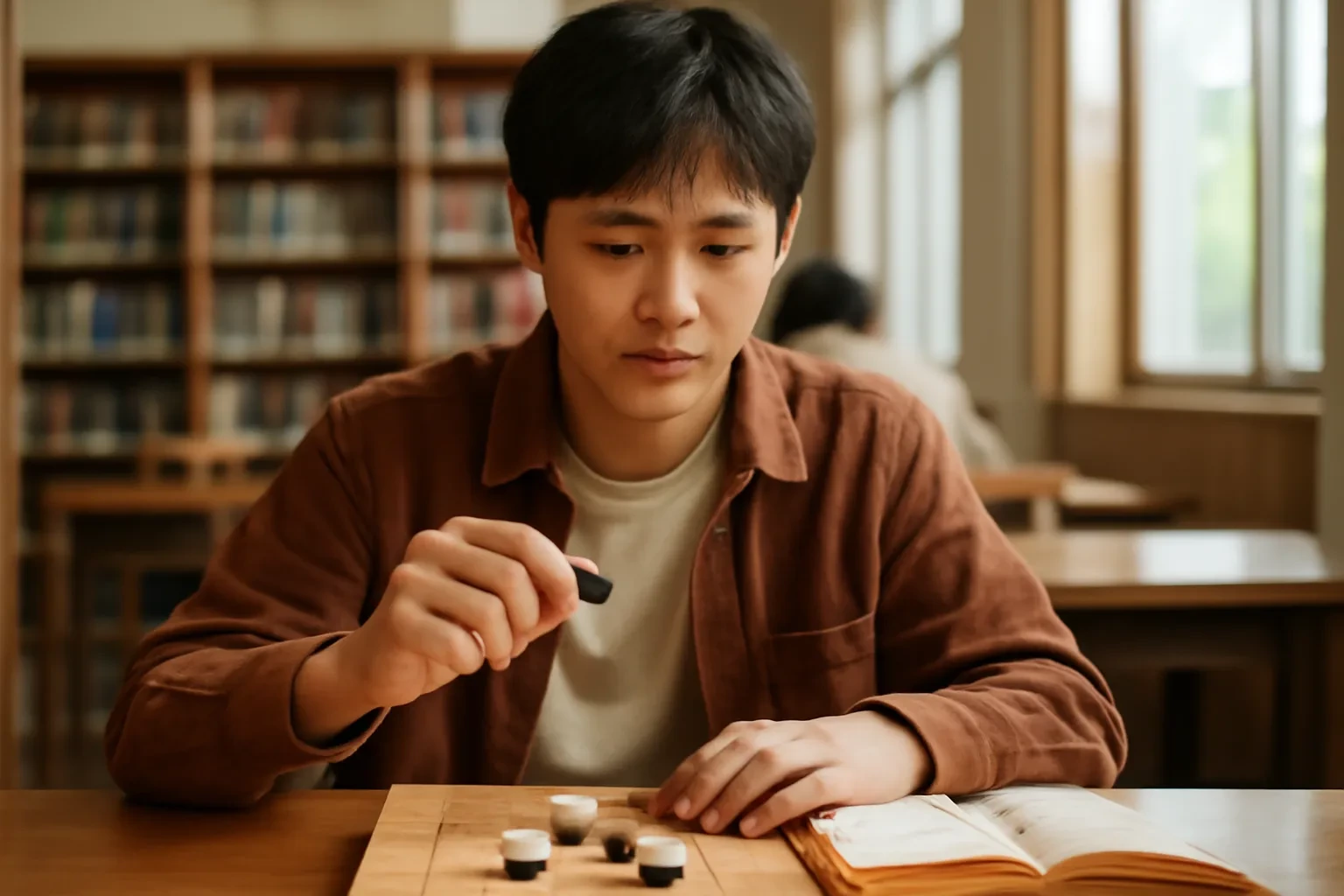
Every Go player eventually hears the word joseki. It sounds technical, and books of joseki can be enormous. In fact the idea is simple, and a beginner needs only a few of them. This article explains what joseki are, why they matter, and — just as importantly — why memorising them too early can make you weaker, not stronger.
The definition
A joseki is a standard sequence of moves in a corner, usually in the opening, that is considered fair to both sides. After the sequence, neither player has made a clear local mistake: one may have territory, the other influence, or they may share the corner and side. The word is Japanese; the same idea is called dingshi in Chinese and jeongseok in Korean.
Joseki are the result of centuries of experience, and in recent years computer programs have also changed which sequences are considered best. They are a kind of shared knowledge about what works locally.
Why joseki exist
The corners are where most games begin, and the same situations appear again and again: a stone on the star point, an approach, an invasion at 3-3. Over time, players found the moves that give balanced results in these recurring situations. Learning them saves you from having to work everything out from scratch every game — and from falling into known traps.
The catch: local fairness is not global fairness
A joseki is fair locally, in the corner. But the value of the result depends on the whole board. A joseki that gives you a strong wall is excellent if the wall faces open space, and poor if it faces your opponent's solid territory. That is the idea of direction of play.
This is why strong players say: "Learning joseki loses you two stones of strength" — a tongue-in-cheek warning that memorising sequences without understanding them makes you play worse, because you choose the right moves in the wrong situation.
How beginners should approach joseki
- Understand a few basic ones well. For most players, the star-point approach and the 3-3 invasion, and one or two sequences after a 3-4 point, are enough for a long time. See the star-point approach joseki and the 3-4 point small knight approach.
- Learn why each move is played. For every move ask: what does it protect, what does it threaten, what does it build?
- Pay attention to the end result. Who got territory, who got influence, which way does each side face?
- Choose by direction. When a joseki offers choices, pick the one that works with the rest of the board. See choosing joseki by direction.
- Know what to do when the opponent deviates. Most beginner opponents will not play the textbook move. Knowing the ideas lets you punish or simply answer sensibly.
What joseki look like on the board
From here there are several well-known continuations. Each gives a slightly different balance of territory and influence. None is "the" correct move; the right choice depends on the other corners.
Common misunderstandings
- "Joseki are the best moves." They are fair moves locally. The best move may be elsewhere, or a different joseki.
- "If my opponent leaves the joseki, they made a mistake." Sometimes. Sometimes they chose a better move for the whole board.
- "I must finish the joseki." No. Leaving a corner sequence unfinished to play a bigger point is often correct, as long as nothing urgent is left behind.
- "I need to know hundreds of joseki." Not at all, especially as a beginner.
Joseki on different board sizes
Joseki mostly belong to 13 × 13 and 19 × 19. On 9 × 9 the board is too small for most sequences to play out normally. If you are learning on 9 × 9, focus on fighting, shape and life and death first; joseki will make sense later.
Practising joseki
Try a joseki you have just learned in several 13 × 13 games against the computer on the home page. Notice how the computer deviates and what happens. Then play people on the online page, sign in on your account to save the games, and replay the corner sequences. Ask: did the result match what the joseki promised? Did the direction fit the rest of the board?
The common pitfalls are collected in joseki mistakes beginners make, and should you memorize joseki? discusses how much to study.
A good way to think about joseki
Think of joseki as good examples, not rules. Each one shows how two players can share a corner fairly. Once you have seen enough of them, you start to feel the shapes and the balance — and that feeling is what really makes you stronger.
A short history in plain terms
Standard corner play developed over centuries as players recorded and studied their games. Particular sequences were refined because they kept producing balanced results. In the last decade, strong computer programs trained on self-play reshaped this knowledge: some sequences once thought standard were found to be slightly worse, and moves that had been considered unusual, such as the very early 3-3 invasion, became common. The lesson for learners is that joseki are a living body of knowledge. The ideas behind them — balance, direction, efficiency — last much longer than any particular sequence.
A beginner's joseki toolkit
If you want a concrete starting point, learn these three situations and understand them well:
- how to answer an approach to your star point with a calm, protective move;
- which side to block from when your star point is invaded at 3-3;
- how to answer a small knight approach to your 3-4 point with a simple move that keeps the corner.
With these three, you can play the opening of most 13 × 13 and 19 × 19 games without disasters in the corners.
Frequently asked questions
Is joseki the same as the opening?
No. The opening of the whole board is called fuseki. Joseki are sequences within one corner.
Do professionals still use joseki?
Yes, though the sequences considered best have changed over time, especially since strong computer programs appeared.
How many joseki should a beginner learn?
Two or three simple ones, understood well, are plenty for a long time.
What if my opponent plays a move not in the joseki?
Think about the ideas: which stones are weak, what is being threatened, what can you build? Often the non-joseki move can be punished simply.
Can I play joseki on 9 × 9?
Rarely. The board is too small; focus on fighting and life and death instead.