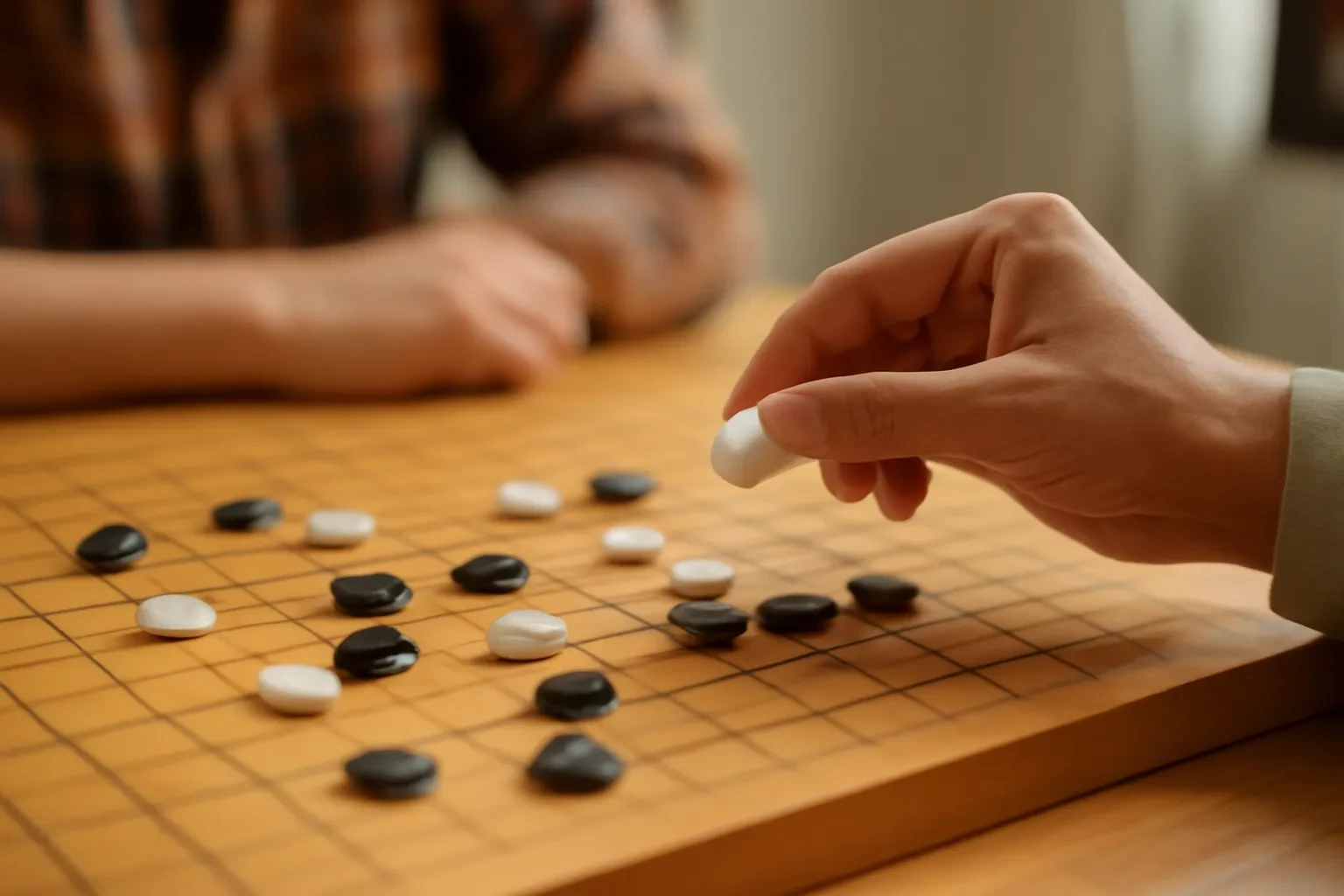
In the endgame of Go, every move gains something, but not every move gains the same amount. Choosing the biggest move each time is the whole art of yose. To do that, you need a way to estimate how much a move is worth. This article gives a practical method that works without memorising tables, and explains the most common traps.
The core idea: compare two futures
For any endgame point, imagine two futures:
- You play there, and the local area is settled the way you want.
- Your opponent plays there, and the local area is settled the way they want.
Count the score in the local area in each case. The difference between the two results is what is at stake at that point. If you playing there gives you six points more than your opponent playing there, the point involves a swing of six.
This single comparison is the foundation of endgame counting. Everything else is detail.
Local counting
You do not need to count the whole board. Only count the area affected by the move:
- The empty points that become yours or theirs.
- Any stones that get captured or saved.
Under area scoring, which this site uses, stones on the board count as well as surrounded empty points. But in endgame comparisons the difference usually comes out the same as under territory scoring, because both futures place the same number of stones in the area. For practical purposes, count the empty points each side gains and any captures.
Gote and sente values
Once you know the swing, adjust it for who gets the next move.
- Gote move. If the move is gote either way, many players describe its value as half the swing, because in practice each side can expect to get it about half the time. A move with a swing of six is often called "worth three in gote." Other players simply use the full swing and compare gote moves with each other. Either convention works as long as you use one consistently.
- Sente move. If the move is sente for you, you get the points and the next move. Compare it with gote moves using the rough rule that a sente move is worth about twice a gote move of the same size.
- Double sente. Whoever plays it gains the swing and keeps the initiative. Play these first.
The article on sente and gote in the endgame explains why initiative matters so much.
Worked example in words
Suppose there is a gap on the second line between your territory and your opponent's.
- If you play a hane into their side and they block, you gain two points on their side and keep your side safe.
- If they play a hane into your side and you block, they gain two points on your side.
The swing is roughly four points. If the hane is gote for both sides, it is a moderate gote move. If it is sente for one side, that side can often wait to play it, but should not wait too long.
Now compare it to another place where one move decides whether a corner of eight empty points belongs to you or to your opponent. That swing is much larger. Play there first.
Common values to recognise
Over time, you will learn that some shapes tend to have similar values:
- First-line moves near the end of the game are usually worth a point or two.
- Second-line hanes at the edge of a territory are usually worth more, often several points, and are frequently sente.
- Moves that save or capture a stone in the endgame can be surprisingly large, because they change both territory and the count of stones.
- Ko fights in the endgame have values that depend on the number of ko threats; treat them carefully.
You do not need to memorise numbers. Recognising which shapes are usually large and which are usually small is enough to improve your choices.
Traps in endgame counting
- Counting only one side. Players often count how much they gain but forget how much they would lose if the opponent played there. Always compare both futures.
- Ignoring follow-ups. A move might look small but set up a larger follow-up move. Count the follow-up as part of its value when it is likely to happen.
- Chasing small sente while a big gote waits. Sente is good, but a small sente move does not beat a much bigger gote move.
- Forgetting dead stones. On this site, stones are counted as they stand after two passes. A dead stone left in your territory costs you. Capture it before passing, even though it looks like a tiny move.
Neutral points
At the very end, only neutral points remain: points that belong to nobody. Under area scoring each neutral point you fill is worth one point, so fill them before passing. There is a separate article on dame and neutral points.
Building the habit
Counting move values sounds tiring, and at first it is. But the habit gets fast. A good exercise:
- Play a 9×9 game against the computer on the home page.
- When the endgame starts, list every remaining boundary point.
- Estimate the swing of each and sort them.
- Play them in order, adjusting for sente.
After a dozen games, you will estimate most moves at a glance. Sign in on the account page to save your games and replay the endgame later. Try your counting against people on the online page.
When numbers are hard, compare shapes
Sometimes you cannot count a move precisely, because the follow-ups are long or depend on ko. In those cases, compare the shapes instead. Which move changes more points of territory? Which move threatens something that your opponent must answer? Which move leaves your own stones with fewer weaknesses? Even without exact numbers, these questions usually point to the right choice.
Another useful trick is to compare pairs. If two borders look similar, imagine playing both and see which one your opponent would rather answer. The one they would hate to lose is usually the bigger one. Over time, you build a sense of size that works faster than counting, and you only count carefully when two moves look close.
Frequently asked questions
How do I find the value of an endgame move?
Compare the local result if you play there with the result if your opponent plays there. The difference is the swing.
Why do some players halve the value of gote moves?
Because each side can expect to get a gote point about half the time. It is a convention; use one method consistently.
Is a sente move always worth more?
As a rough guide, a sente move is worth about twice a gote move of the same size. A much bigger gote move can still be more urgent.
Do I need exact numbers?
No. Knowing which moves are big and which are small already helps a lot.
Does area scoring change endgame values?
Very little in practice. The main difference is that neutral points are worth one point each, so fill them before passing.