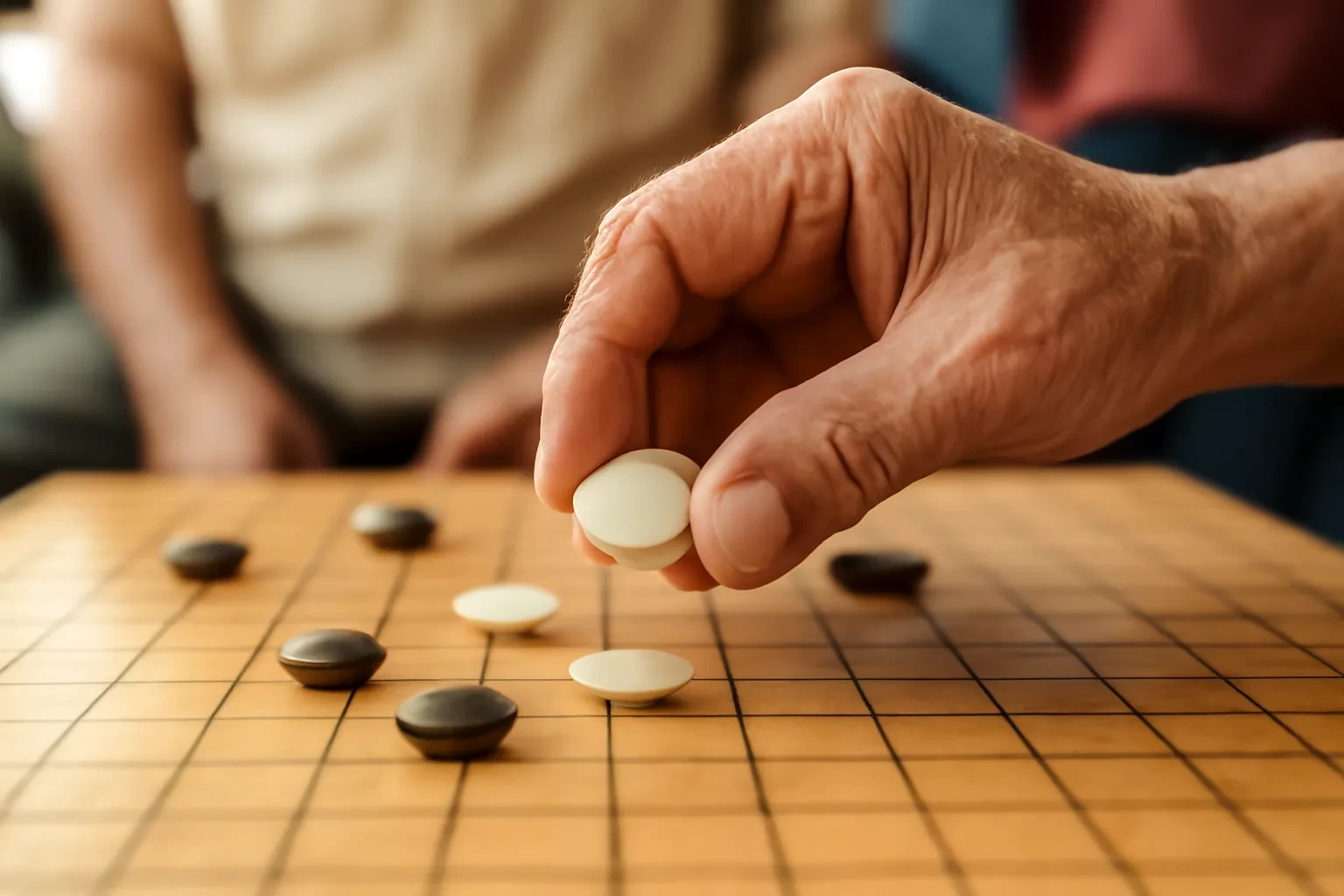
Go has a reputation for being the hardest board game in the world. The strategy is deep, that part is true. The rules are not. You can learn everything you need to play a complete game in about ten minutes, and this article covers all of it. After that, the fastest way to understand the rules is to play a few quick games on a small board.
The board and the stones
Go is played on a grid of lines. The full-size board has 19 × 19 lines, but beginners almost always start on 9 × 9 and then move up to 13 × 13. The rules are identical on every size; only the length of the game changes.
Stones are placed on the intersections of the lines, not inside the squares. This is the first thing that surprises people who know chess or checkers. The corners and the edges count too: a stone can sit on the very edge of the board or in the corner point.
One player has black stones and the other has white. Black moves first. Players then take turns placing one stone at a time on any empty intersection. Once a stone is placed, it never moves. It stays where it is until the end of the game, unless it is captured.
That is the whole mechanics of a turn: pick an empty point, put your stone there. There is no moving, no jumping, no promotion.
The goal
The aim of Go is to surround more of the board than your opponent. At the end of the game, each player counts the area they control, and the larger total wins. On this site we use area scoring: your score is the number of your stones on the board plus the number of empty points completely surrounded by your stones. White also receives komi, a bonus of 7.5 points, to make up for Black moving first. The half point means there can be no ties.
Capturing enemy stones is important, but it is a means rather than the goal. Many strong games are won with very few captures.
Liberties
Every stone needs breathing space. The empty points directly next to a stone — up, down, left and right, never diagonally — are called its liberties.
A stone on the edge has only three liberties, and a stone in the corner has just two. That is why stones near the edge are easier to capture — and why, as we will see later, the corners are also the easiest place to build territory.
Stones of the same colour that touch each other along the lines form a group (sometimes called a chain). A group shares its liberties: the group is alive as long as at least one empty point touches any stone in it.
Capturing
When you occupy the last liberty of an enemy stone or group, that stone or group is captured and removed from the board. The captured points become empty again.
When a stone or group has only one liberty left, it is said to be in atari. The player in atari usually has two choices: extend the group to gain more liberties, or give it up and play somewhere more valuable.
You cannot commit suicide
You are not allowed to place a stone where it would have no liberties at all, unless that move captures something. If your stone lands in a point where it has zero liberties but the move takes away the last liberty of enemy stones, those enemy stones are removed first, and your stone then has liberties — so the move is legal.
Some rule sets allow suicide of a whole group; the rules used on this site, like most rule sets you will meet, do not allow it.
Ko: no endless back-and-forth
Sometimes a single capture creates a position where the opponent could immediately capture back, and then you could capture back again, forever. This shape is called a ko.
The ko rule says you may not make a move that recreates a board position that has appeared before. In practice this means that after your opponent takes a ko, you must play somewhere else first (a "ko threat") before you can take it back. The version used on this site is called positional superko: any full-board repetition is forbidden, not just the immediate one. For beginners the effect is the same: after a ko capture, play elsewhere first.
Ko fights are one of the most exciting parts of Go. There is a whole article on the ko rule if you want the details.
Passing and the end of the game
At any time, instead of placing a stone, you may pass. When both players pass one after the other, the game ends.
On many real-world boards the players then agree which stones are "dead" — stones that would inevitably be captured — and remove them before counting. On this site the scoring is automatic and literal: every stone on the board counts as alive. So before you pass, you should capture any enemy stones sitting inside your area. If you pass while a hopeless enemy stone is still inside your territory, the computer will count that point for your opponent's stone, and it can cost you the game.
The rule of thumb: when the borders are closed and there is nothing left to capture, pass.
Counting the score
With area scoring, the count is simple:
- Count your stones on the board.
- Count the empty points surrounded only by your stones.
- Add them together. White adds 7.5 komi.
Empty points that touch both colours are neutral and count for nobody. The player with the higher total wins.
Resigning
You may also resign at any time. In Go this is normal and polite when the game is clearly lost; players often resign rather than play out a long game they cannot win.
The whole rulebook in one list
- Players place one stone per turn on an empty intersection; Black starts.
- Stones never move.
- A group with no liberties is captured and removed.
- You may not play a move that leaves your own stone without liberties, unless it captures.
- You may not recreate a previous board position (ko).
- You may pass; two passes in a row end the game.
- The larger area wins, with 7.5 komi for White.
That is really all. Everything else — ladders, nets, eyes, joseki — is strategy that grows out of these seven rules.
How to learn from here
The best next step is to play. Start on a 9 × 9 board against the computer on the home page, where one game takes only a few minutes. Try to capture stones, watch what happens at the edges, and notice when a group of yours starts to feel short of breath. Then read about liberties and capturing and about why beginners should start on 9 × 9.
When you are ready to face real people, the online page lets you find an opponent or send a link to a friend. If you sign in on the account page, your games are saved and you can replay them move by move afterwards, which is the easiest way to see where things went wrong.
Frequently asked questions
Is Go the same game as weiqi and baduk?
Yes. Go is the Japanese-derived name used in English. In Chinese the game is called weiqi, in Korean baduk, and in Vietnamese cờ vây. The rules are the same game; the small differences between national rule sets mostly concern how the score is counted at the end.
Do I need to learn the 19 × 19 board first?
No. Almost every teacher recommends starting on 9 × 9. The rules are identical, the games are short, and you see the results of your mistakes quickly. Move to 13 × 13 when 9 × 9 starts to feel familiar.
Can a stone be placed inside the opponent's territory?
Yes, any empty point is allowed as long as the move is not suicide and does not repeat a previous position. Such stones are often captured, but sometimes they live — that is called an invasion.
Why does White get 7.5 points?
Moving first is an advantage. Komi compensates White for it. The half point prevents draws.
What happens if both players pass but there are still dead stones on the board?
On this site the count is literal: every stone on the board is counted as alive. Capture hopeless enemy stones before passing, and do not leave your own stones stranded inside your opponent's area.