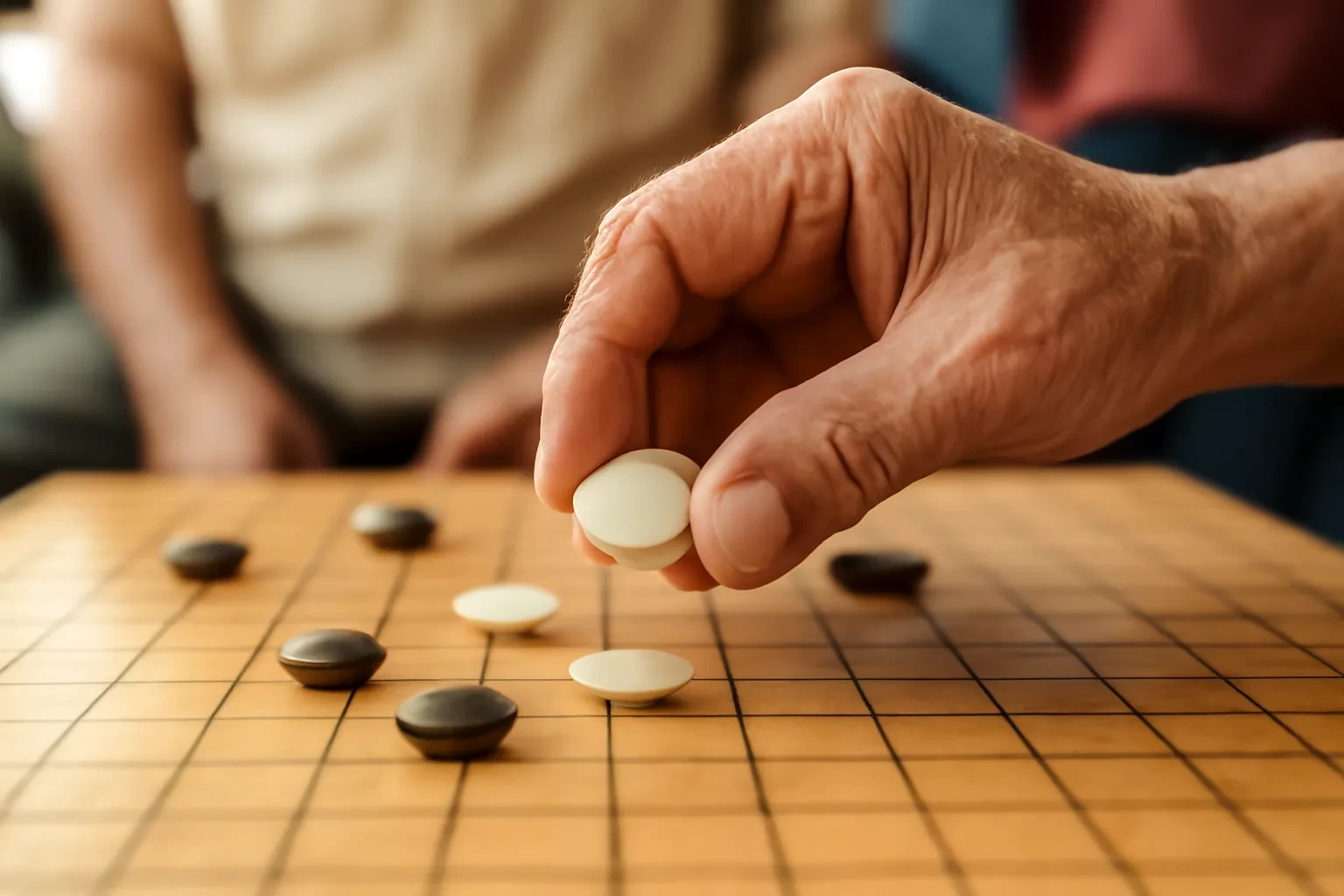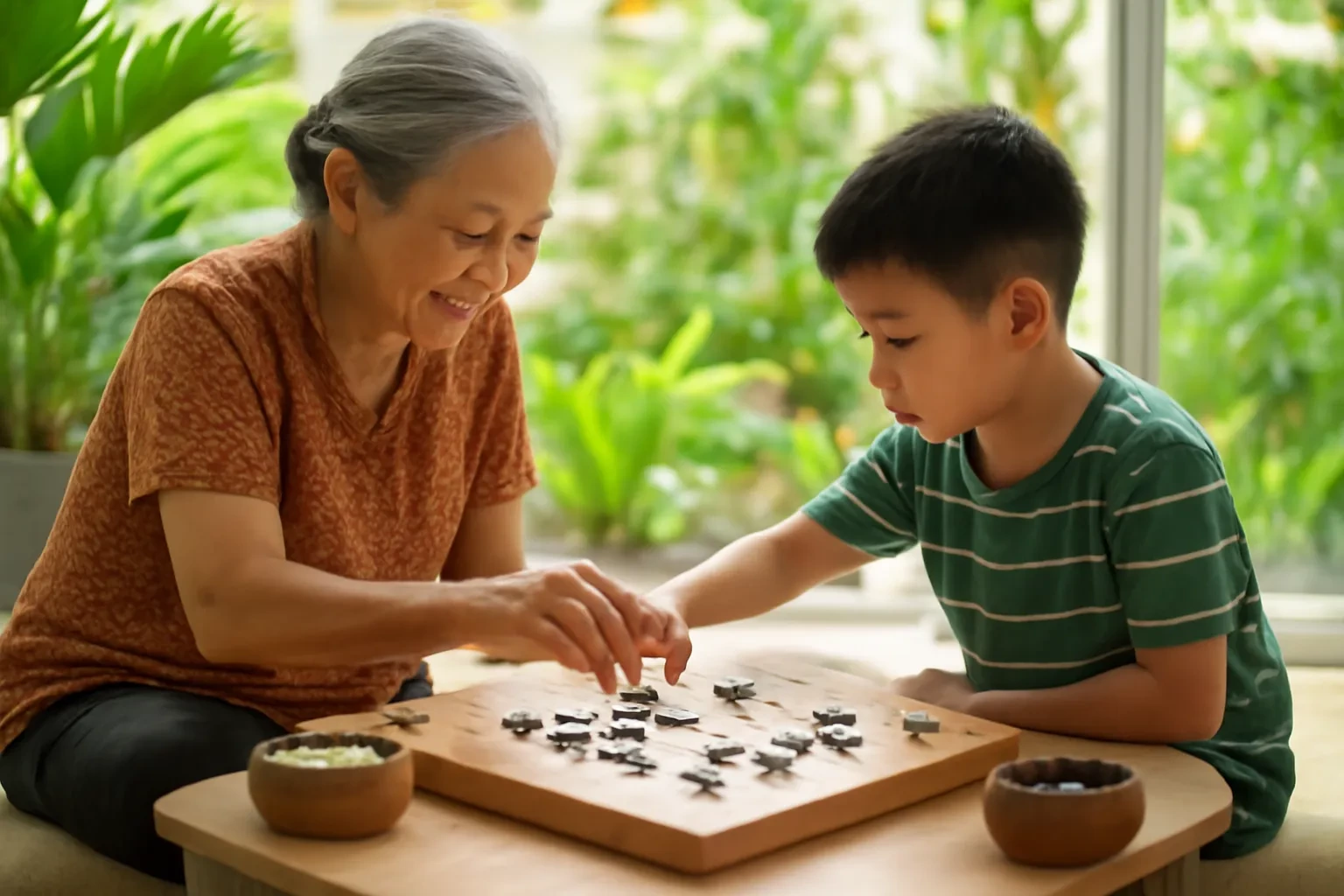
One of the most beautiful features of Go is its handicap system. In most games, a beginner playing an experienced player simply loses, over and over. In Go, the weaker player can receive a few free stones at the start, and suddenly the game is close and interesting for both sides. Parents can play their children, teachers their students, and friends of different strengths can enjoy the same board.
How it works
In a handicap game:
- The weaker player takes Black.
- Before the game, Black places a number of stones — the handicap — on fixed points of the board.
- White then moves first, since Black has already had "extra moves".
- Komi is reduced, usually to 0.5 points, so White does not also receive compensation for moving second.
A two-stone handicap means Black places two stones; a nine-stone handicap, nine. On the 19 × 19 board, handicaps of up to nine stones are standard. On small boards, fewer stones make a big difference.
Where the stones go
Handicap stones are placed on the star points (the dots printed on the board), in a traditional pattern. On 19 × 19, two stones go on opposite corner star points, four stones on all four corners, five add the centre, and so on up to nine.
On 9 × 9 and 13 × 13 the star points are the same idea on a smaller scale. Online servers often let the players agree on free placement instead; the fixed placement is still the most common.
How many stones?
The traditional rule on the full board is that one grade of difference is worth about one stone. Players are ranked in kyu grades (beginners count down from around 30 kyu toward 1 kyu) and then dan grades. A player who is three grades weaker would take a three-stone handicap.
On smaller boards each stone is worth much more, because the board is so much smaller. A two-stone handicap on 9 × 9 is already a big advantage. When you play a friend, the simplest method is practical: if one player keeps winning easily, add a stone; if the weaker player starts winning, remove one.
Playing with a handicap (as Black)
Handicap stones are powerful, but only if you use them well. Common advice:
- Keep your stones connected to each other and to the corners. Each handicap stone controls a corner or area. Your job is to make sure White cannot pick them off one by one.
- Do not panic when White invades. White must invade to have a chance. You do not need to kill every invasion; letting White live small while you strengthen your own groups often wins.
- Play solidly. You are ahead from the start. Avoid wild fights you do not understand; simple, safe moves keep the lead.
- Watch for White's cutting points. White will try to cut your stones apart and then attack both halves.
Playing against a handicap (as White)
As White you start behind, so you need to create chances:
- Invade and reduce early, before Black's corners become solid territory.
- Make Black's stones work harder: approach them, build your own strength, and look for weaknesses.
- Be patient. A handicap game against a weaker player is won by accumulating small advantages and by the weaker player's mistakes, not by a single brilliant trick.
Handicaps and the computer
On this site, the computer opponent on the home page has four levels rather than a handicap system. That is another way of getting a fair game: choose the level that gives you a close fight. If you win easily, move up.
When you play friends on the online page, you can agree on colours and play as many games as you like. If you want to learn from handicap games, sign in on your account so your games are saved, and look at how the handicap stones were attacked and defended.
Why handicaps are good for learning
A handicap game lets a weaker player experience real Go: fights, invasions, life and death, all in a game that is not decided in the first twenty moves. The stronger player, meanwhile, has to play sharply rather than coasting. Many clubs use handicaps for almost every game between members of different strengths, and many teachers say that playing lots of handicap games against stronger players is one of the fastest ways to improve.
If you are just starting, read how to start playing Go and Go rules for beginners first.
A small-board example
On a 9 × 9 board, a two-stone handicap is huge. Black starts with stones on two opposite star points, which already stake a claim to two corners. White must immediately find space somewhere, and every white group risks being squeezed between the handicap stones. A beginner playing Black with two stones against a much stronger friend on 9 × 9 will often have a genuinely close game.
On 13 × 13, handicaps of two to four stones are common between players of quite different strengths. On 19 × 19, even a nine-stone handicap is standard between a beginner and a strong club player.
Reverse komi and small adjustments
Sometimes the difference between two players is less than one stone. In that case players simply play even games and adjust komi, or alternate colours. Some clubs use "reverse komi", where Black receives points instead of giving them, for very small differences. For casual games between friends, alternating who takes Black is the easiest fair arrangement.
Etiquette in handicap games
Traditionally, the weaker player places the handicap stones and the stronger player thanks them for the game at the end, as in any game. It is considered good manners for the stronger player to play seriously rather than carelessly — a handicap game is a real game, and playing properly is the best way to help the weaker player learn. The weaker player, in turn, should not feel embarrassed about taking stones: handicaps exist precisely so that people of different strengths can enjoy the same board.
How handicaps change as you improve
A nice side effect of handicap games is that they measure progress. If you once needed four stones against a friend and now win with three, you have improved by roughly one grade. Many players find this more motivating than any rating number, because it is concrete: one less stone on the board.
Frequently asked questions
Who moves first in a handicap game?
White. Black has already placed the handicap stones, so White makes the first move on the empty part of the board.
Is komi used in handicap games?
Usually a token komi of 0.5 points is used, just to prevent draws. The large 7.5 komi applies only to even games.
How big a handicap should I take?
On the full board, roughly one stone per grade of difference. On small boards, start with one or two stones and adjust until games are close.
Can handicap stones be captured?
Yes. They are ordinary stones. Keeping them connected and safe is Black's main task.
Are handicap games less valuable than even games?
No. Many players learn faster from handicap games, because every game is competitive and full of real fighting.