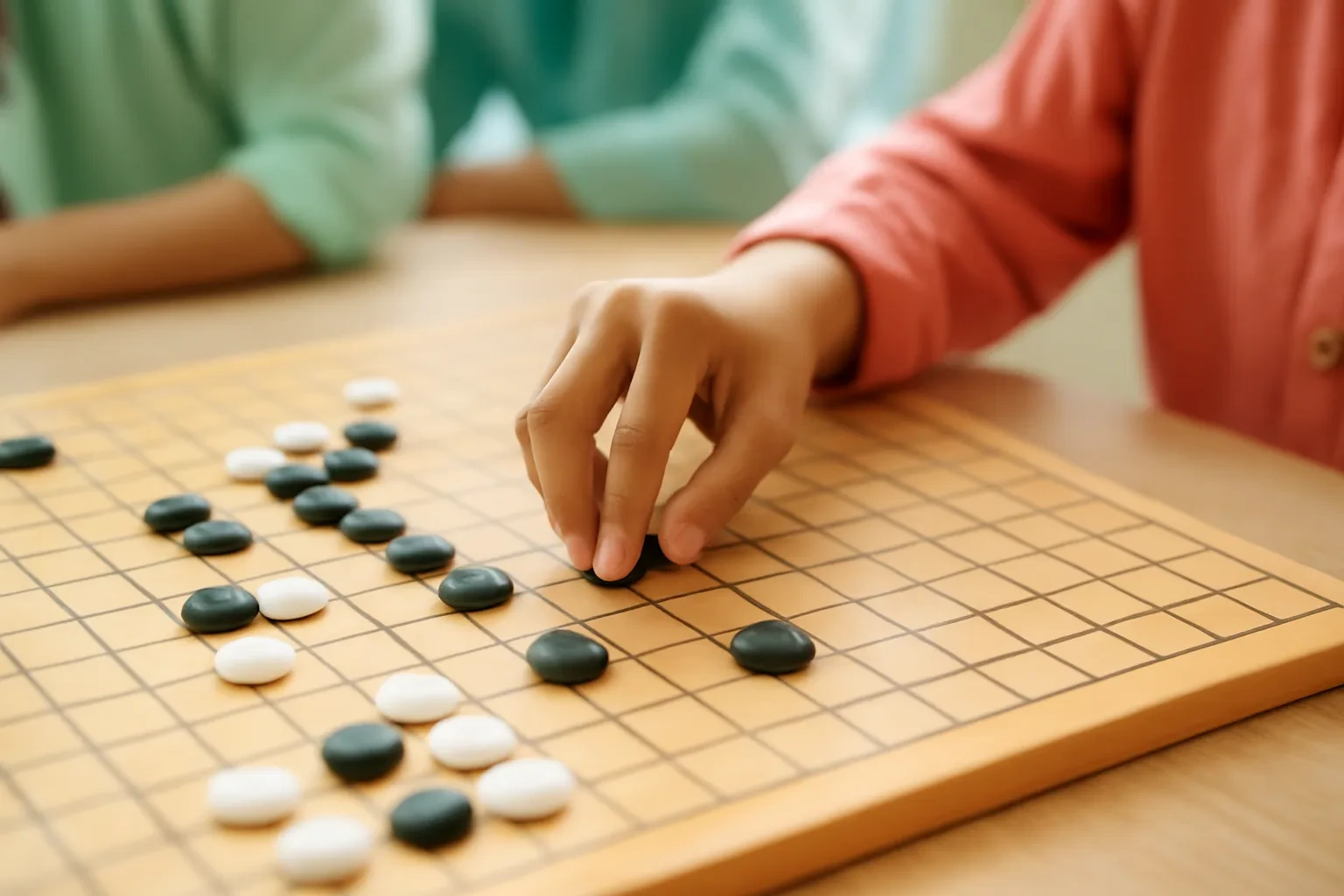
On the full board, most games begin with each player taking corners. But where exactly in the corner? Two points dominate modern play: the 4-4 point, also called the star point, and the 3-4 point. Each has a different character, and choosing between them shapes the whole opening. This article explains both in plain terms.
Naming the points
Corner points are named by their distance from the two edges. The 4-4 point is four lines from both edges. The 3-4 point is three lines from one edge and four from the other. On a 19 × 19 board the 4-4 points are marked with dots — the star points — which is where the name comes from.
On a 13 × 13 board the same points exist: the star points are 4-4 as well.
The star point (4-4)
A stone on the star point:
- Claims the corner in one move. It does not need a second move to be settled.
- Faces the centre and both sides equally. It is good for building frameworks.
- Leaves the 3-3 point open. The opponent can later invade at 3-3, underneath the star point, and often live in the corner.
The star point trades some corner security for speed and flexibility. Players who like to build influence and fight in the centre often choose it.
The 3-4 point
A stone on the 3-4 point:
- Is closer to the corner, so the corner territory is more secure.
- Is lopsided: it faces one side more than the other.
- Often needs a second move (called an enclosure) to fully secure the corner. With two stones, the corner is very solid.
- Invites an approach from the opponent, which leads to joseki — standard sequences.
The 3-4 point leans toward territory and solid play. Many players consider it the more classical choice.
Which should a beginner choose?
Either is fine, but many teachers suggest beginners start with the star point:
- It needs only one move per corner, which leaves more time for the rest of the board.
- The follow-up sequences are relatively simple.
- The main risk — the 3-3 invasion — is easy to understand once you have seen it a few times.
Others prefer the 3-4 point because it teaches solid, territorial habits. The honest answer is: pick one, play it for a while, then try the other. Understanding both makes you stronger.
Other corner points
You will also see:
- 3-3: very secure territory, very low; rarely played as the first move in a corner in modern games, but important as an invasion point.
- 5-4 and 5-3: higher, more influence-oriented moves, less common and trickier.
As a beginner, stay with 4-4 and 3-4.
How the choice affects the whole board
If you take star points, your stones look outward; plan to build frameworks along the sides. If you take 3-4 points, plan to enclose corners and extend along the sides for territory. Mixing the two is also common. What matters is that your later moves work with your corners rather than against them — a theme explored in direction of play.
Common follow-ups
After the star point, the most common events are:
- The opponent approaches from the side; you answer to protect the corner or build on the other side.
- The opponent invades at 3-3; you block from the direction that works best with your other stones.
After the 3-4 point, the most common events are:
- You enclose the corner with a second stone.
- The opponent approaches, leading to a joseki.
The joseki category covers these in detail, starting with what is joseki, the star-point approach and the 3-4 point small knight.
Try it
Play several 13 × 13 games against the computer on the home page using only star points for your first moves, then several using 3-4 points. Notice how the games feel different. Then play people on the online page and save your games on your account to compare.
A note on small boards
On 9 × 9 the corner points behave differently, because the board is so small. The 3-3 and 4-4 points on 9 × 9 are only a couple of lines from the centre, and the first move often goes to the centre point instead. See opening on 9 × 9.
What the choice says about your style
Players often notice that their corner choice matches their temperament. Those who enjoy calm, solid games and like to count territory often gravitate to the 3-4 point and quick enclosures. Those who enjoy big frameworks and centre fights often prefer the star point. Neither style is superior; strong players adapt to the position and to the opponent. But for a beginner, choosing the corner move that matches your natural style makes the opening more enjoyable and your plans more consistent.
Trying both in practice
A good experiment is to play five 13 × 13 games with star points only, then five with 3-4 points only, against the same computer level. Note how often your corners were invaded, how often you had to add a defensive move, and how much territory you had at the end. Most players find that star-point games feel faster and more open, with more fighting, while 3-4 games feel calmer and more territorial. Neither result is wrong; it simply tells you which style you enjoy, and that is a perfectly good reason to choose.
A word on the empty corner
Whatever you choose, remember that an empty corner is one of the biggest points on the board early in the game. Taking a corner with a slightly imperfect move is almost always better than leaving it empty while you play something smaller.
Frequently asked questions
Why is the 4-4 point called the star point?
Because on a real board the 4-4 points are marked with small dots, called star points (hoshi in Japanese).
Is the 3-3 invasion under a star point always possible?
Very often, especially early in the game. How well it works depends on the surrounding stones.
Do I need to enclose my 3-4 corner immediately?
Not always. If something more urgent is happening, play there first. But an unenclosed 3-4 stone invites an approach.
Which point makes more territory?
The 3-4 point, and especially the enclosed corner, is more reliable territory. The star point makes territory less securely but gains influence.
Can I play both in one game?
Yes, many players mix them to balance territory and influence.