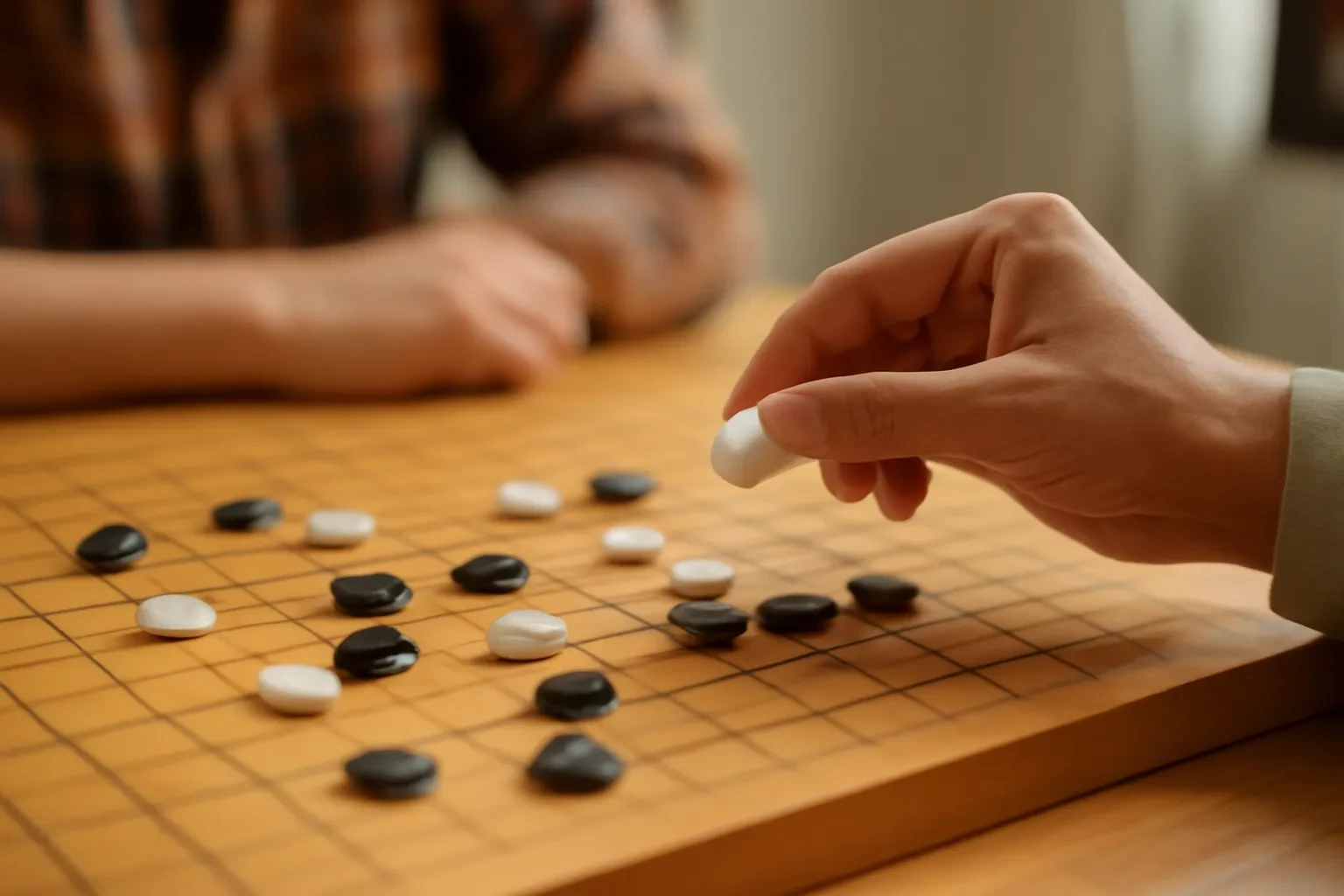
By the time the endgame arrives, most of the board is divided. What remains are the borders: the lines where your territory meets your opponent's. Closing those borders well, one after another, is most of what the endgame is. A player who closes borders efficiently gains a few points on each side, and those points add up.
This article covers the small shapes that appear again and again when closing borders, and the thinking behind choosing between them.
Why borders matter
A border that is not closed is a gap. Through a gap, your opponent can push a stone into your area, reducing it. If you close the gap first, you keep the points. If you close it by pushing into their side instead, you gain a little extra. The choice between defending your side and pushing into theirs is the basic decision at every border.
The hane
A hane is a move that bends around the end of your opponent's line of stones, touching it diagonally. On the edge, a hane on the second line pushes into your opponent's area and reduces it by a few points.
The hane is often sente: if your opponent does not block, you can push further or cut. After they block, you usually need to connect or protect your own cutting point, and that decides whether the sequence ends in sente or gote.
Hane moves are among the most common and valuable endgame moves. When two borders are open, the player who plays the hane first usually gains.
The block
A block stops your opponent's stone from pushing further. When your opponent plays a hane into your area, blocking is the normal answer. Blocking gives up the points they already gained but prevents more.
Sometimes blocking is dangerous because it leaves your own stones with a cutting point. In that case you may need to block and then connect, spending a move. Reading whether the block leaves a weakness is part of closing borders safely.
The descent
A descent is a move that extends straight down toward the edge, from the second line to the first, for example. It closes a border solidly and often prepares a later hane. Descents look slow, but they can be sente if they threaten to push into your opponent's area on the next move.
Players sometimes underestimate descents because they do not touch the opponent directly. A well-timed descent can gain as much as a hane without leaving weaknesses.
First-line hane and connection
Very late in the game, borders are closed on the first line. A first-line hane followed by a connection is worth only a point or two, but in a close game those points decide the result. Do not skip them; just play them after the bigger moves.
Choosing between defending and attacking a border
At each open border, you have roughly three choices:
- Defend your side with a solid move. Safe, usually gote.
- Push into their side with a hane or descent. Gains more, often sente, but may leave weaknesses.
- Leave it and play a bigger move elsewhere.
Use the method from endgame move values: compare the result if you play there with the result if your opponent plays there, then decide which border is biggest. Among borders of similar size, play the one that keeps sente.
Cutting points at the border
Most mistakes in closing borders come from cutting points. When you hane, your opponent may be able to cut behind it. When you block, your own stones may have a gap. Before each border move, check:
- After this move, can my opponent cut?
- If they cut, can I capture the cutting stone, or will I lose points?
If a cut works against you, add a connecting move first or choose a more solid shape. A border closed with a hole in it is not closed.
A small example
On a board like this, the big borders are closed and only first-line points remain. They are small, but they are still points. Under area scoring, which this site uses, each of these boundary stones also counts when the game is scored, so filling them correctly is worth doing.
Borders on this site
This site uses area scoring with komi 7.5, and the game ends when both players pass in a row. After closing all borders:
- Fill any remaining neutral points.
- Capture any dead stones inside your area.
- Then pass.
If you pass with open borders, your opponent can keep playing into them. If you pass with dead stones in your area, they count as alive.
Practice
Endgame shapes become natural with repetition. Play short 9×9 games against the computer on the home page and pay attention to how each border is closed. After the game, sign in on the account page to replay the endgame and look for borders where you defended when you could have pushed, or pushed where a cut punished you.
Against people on the online page, watch how stronger opponents close borders: they usually play hanes first and connect only when needed. For more, read sente and gote in the endgame and what is yose.
A checklist for each border
When you look at an open border, run through the same short list every time. First, find the exact point where the two sides meet: the last stone of each colour on that line. Second, ask which side the gap favours; often one player can push in and the other can only block. Third, look for cutting points on both sides of the border, since a hane that leaves a cut is a gift to your opponent. Fourth, estimate the swing: how many points change hands depending on who plays first. Fifth, decide whether your move there ends in sente or gote.
This takes a little time at first, but it becomes quick. The value of the checklist is not precision; it is that you stop overlooking borders. Many lost points come from a border that nobody looked at until the opponent played there. When you close borders in a steady, deliberate way, those surprise losses disappear, and your endgame results become much more consistent from one game to the next.
Frequently asked questions
What is a hane?
A move that bends around the end of your opponent's line of stones, touching it diagonally. On the edge it is a common endgame move.
Is it better to defend my border or push into theirs?
Compare the value of both. Pushing into theirs often gains more and keeps sente, but only if it leaves no dangerous cutting point.
What is a descent?
A move extending straight toward the edge. It closes a border solidly and can prepare a later hane.
Why did my hane lose points?
Probably because it left a cutting point. Check for cuts before every border move.
Are first-line moves worth playing?
Yes. They are small but real points, and in close games they decide the result.